
In a groundbreaking move, the UK government has announced a comprehensive plan to combat the obesity epidemic through a healthy food revolution. This initiative aims to make healthier food choices more accessible and appealing to the public, thereby reducing the strain on the National Health Service (NHS) and improving overall public health.
The Obesity Crisis
Obesity has become a significant public health issue in the UK, with alarming statistics highlighting the severity of the problem. According to a forthcoming report by the Chief Medical Officer, more than one in five children are living with obesity by the time they leave primary school. This figure rises to nearly one in three in areas with higher levels of poverty and deprivation. The obesity epidemic not only affects children but also places a substantial burden on the NHS, costing approximately £11 billion annually, which is triple the budget for ambulance services.
The Plan for Change
The government’s Plan for Change is a strategic shift from treatment to prevention, aiming to create a healthier nation. This plan involves a world-first partnership between the government and the food industry to promote healthier food and drink options. The goal is to make the healthy choice the easy choice for consumers, thereby reducing obesity rates and easing pressure on the NHS.
Key Initiatives
- Healthy Food Standard: One of the cornerstones of this initiative is the introduction of a new healthy food standard. Large retailers, including supermarkets, will set a new standard to make the average shopping basket of products sold slightly healthier. This mandatory standard will involve reporting data and setting health targets to ensure that healthier options are more readily available to consumers.
- Calorie Reduction: Public health experts believe that reducing daily calorie intake by just 50 calories could lift 340,000 children and 2 million adults out of obesity. If everyone who is overweight reduced their calorie intake by around 200 calories a day, equivalent to a bottle of fizzy drink, obesity rates could be halved. This simple yet effective measure is a key part of the government’s strategy to combat obesity.
- Investment in Communities: The government is also focusing on investing more in working-class communities where health disparities are greatest. This includes rapid action on maternal mortality gaps in Black, Asian, and working-class communities. By addressing health inequalities, the government aims to create a more equitable health landscape across the UK.
- Transition of the NHS: The Plan for Change also involves transitioning the NHS from a sickness service to a prevention service. This shift will enable the NHS to focus more on preventive measures, thereby reducing the need for treatment and easing the pressure on waiting lists. Health and Social Care Secretary Wes Streeting has emphasised the importance of this transition in creating a healthier nation.
Industry Collaboration
The success of this initiative relies heavily on the collaboration between the government and the food industry. Food retailers and manufacturers are being encouraged to make healthier choices more accessible and appealing to consumers. This partnership is crucial in ensuring that the healthy food standard is implemented effectively and that healthier options are readily available to the public.
Expert Opinions
Experts have welcomed the government’s commitment to tackling the obesity epidemic. Professor Tom Sanders, Professor Emeritus of Nutrition and Dietetics at King’s College London, has highlighted the importance of reducing calorie intake and making healthier choices more accessible. However, he also noted that the claim made in the press release about the impact of reducing daily calorie intake by 50 calories is not a view shared by most experts in nutrition.
Katharine Jenner, director of the Obesity Health Alliance, has described the government’s plan as a fair and evidence-based prescription for better health. She emphasised the need for the government to level the playing field to help businesses focus on selling products that promote healthier lifestyles.
My Opinion as a Dietitian
We really do need proper reform of industry in order to change our food environment. The science is clear; obesity is a complex and multi-faceted issue, with hundreds of thousands of factors impacting an individuals likelihood of obesity. One of the major factors is the environment that we are in.
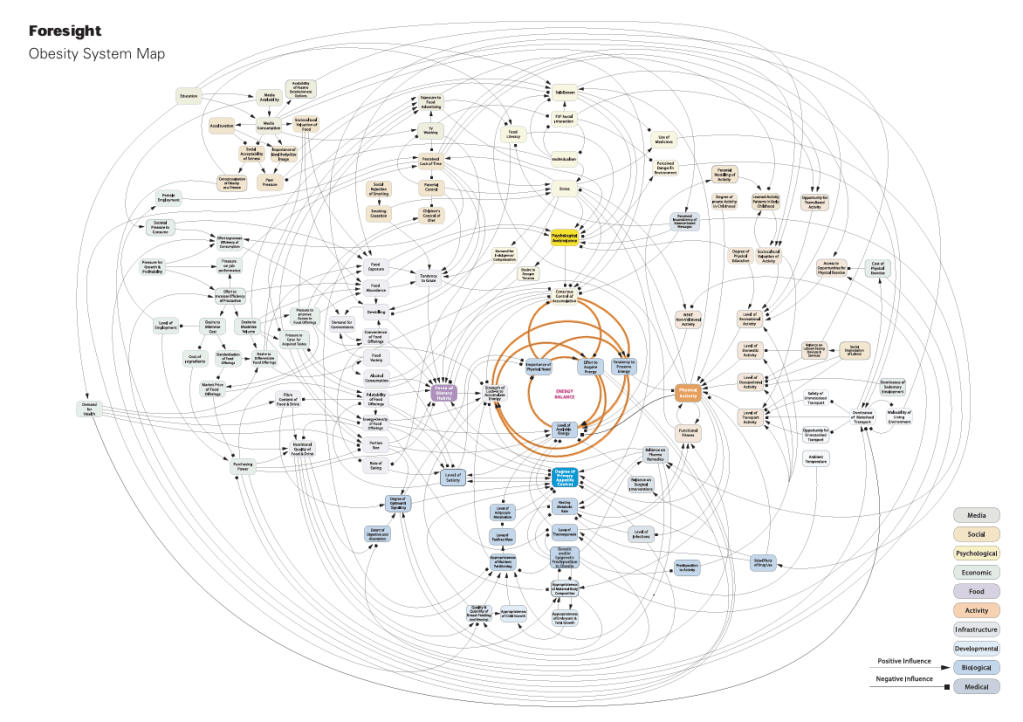
Above: the Foresight report, detailing all of the contributing factors to obesity.
Supermarkets have been able to prioritise sales and profit over health and wellbeing for too long. Advertisements everywhere, snack aisles by the checkouts, higher fat, salt and sugar foods at eye level; and whilst things have slowly begun to change, it’s not enough. This press release shows that the government is at least understanding that we cannot allow industry to police itself, as when we do, profit comes before people.
This being said, I do worry that there is not enough structure and guidance for industry to make meaningful change. The report states that companies can do what they feel works for them to support this change; do we really trust that industry is going to do anything more than the bare minimum? This isn’t going to make much difference in the long run, because industry really only cares about the money it makes.
I also have doubts over the statistic that reducing caloric intake by 50 calories per day will make a meaningful shift in the obesity levels of the nation. I know as a weight loss dietitian that it is often not as simple as reducing calorie intakes by 50 per day to see meaningful differences; if it was, my job would be a lot easier!
What I do think will work incredibly well, however, is investing more money into deprived communities to address health inequalities. We know that deprived communities have worse health outcomes, more obesity and overall worse mortality statistics than non-deprived communities. If we can iron out these inequalities, we can significantly impact the root causes of obesity and obesity related conditions.
Conclusion
The UK government’s healthy food revolution is a bold and necessary step towards tackling the obesity epidemic. By making healthier choices more accessible and appealing, the government aims to reduce obesity rates, ease the strain on the NHS, and create a healthier nation. This initiative, with its focus on prevention and collaboration with the food industry, has the potential to make a significant impact on public health in the UK.
I do worry that many areas of this plan are too “wishy washy”, with a lack of structure and guidance to see real change; but I am at least happy to see them doing something bold to tackle the crisis.
As the government continues to implement its Plan for Change, it is crucial for all stakeholders, including food retailers, manufacturers, and the public, to work together to achieve the goal of a healthier nation. The success of this initiative will not only improve public health but also contribute to a more sustainable and equitable healthcare system.
 Diets Debunked