
I honestly think one of the most bizarre (and frankly, insane) diet trends to come out of the 2020’s is the carnivore diet. A diet where you solely subsist on meat, salt, butter and maybe some other animal products (if you’re feeling adventurous I guess). People who promote such a diet are often peddling anti-science and anti-medicine rhetoric, claiming that saturated fat doesn’t cause heart disease, that plants are poison, and salt is good for you, actually. Let’s pick these arguments apart and explain why carnivore is BS.

Why are they even carnivore anyway?
Many people turn to carnivore because they are desperate. They feel unwell, they might have some health issues or skin conditions which they are trying to solve (IBS and acne are pretty common ones), they might be fatigued or stress or they really need to lose weight but feel unable to do so. I truly do empathise with those who turn to carnivore as they believe it is the last resort. Many of these people have been failed by medical professionals who have not, or refuse to, look into the cause of these conditions, and so they feel as though they need to take matters into their own hands.
One strong part of the confirmation bias we see in carnivores is that they often do end up feeling better when they go on the diet, or they often do see improvements in whatever it is they wanted to fix. I won’t deny this, and it is a fact which often drives them to then hail it as miracle cure. If their acne or IBS was triggered by diet, going on a strict elimination diet like carnivore can fix the issue. If they’ve struggled to lose weight in the past, cutting all processed foods and carbs and only eating a few, simple foods can really help, especially if those foods are high in protein and are therefore, very satiating (which they are in carnivore). If they are consistently eating sugary foods which are leading to sugar crashes, or have a diet that is low in iron, switching to carnivore can make them feel less fatigued as they are removing the sugar and increasing the iron intake.
As I say, I won’t deny that the diet can achieve these things, and I think it is important to acknowledge everyone’s individual experiences. What I will challenge, however, is if the diet is necessary to achieve these goals, and whether these goals could have been achieved with a diet which is less restrictive and more nutritious. The answer, in 99.9% of cases, is no; the diet was not necessary, and there are less intense ways of achieving these goals.
The carnivore beliefs
There is a thread of beliefs which I see through almost all carnivores online.
- Saturated fat is good for you, and seed oils are bad.
- Plants have anti-nutrients and are therefore bad for you.
- Fibre is not absorbed and is therefore not necessary for good health.
- You can achieve all of your nutritional needs with a carnivore diet, and nutrients from carnivore sources are more bio-available and therefore better.
- Salt is good for you and is essential for good health.
- Carbohydrates are non-essential and therefore you don’t need to eat them for optimal health.
Let’s break each of these down and see what the truth is here, shall we?
- Saturated fat is good for you, and seed oils are bad.
The appeal to nature fallacy is strong with this one. Many carnivores will claim that before the 1950’s, when we typically cooked everything in lard, tallow and butter, cardiovascular disease levels were low and it was only when seed oils were introduced that levels increased.
In reality, this was not the case. CVD levels were actually incredibly high in the 1950’s and 60’s until the 1970’s, and since then, rates of CVD in the population and deaths from CVD in the population have been on a steady decline. This is due to a wide variety of reasons; earlier detection and preventative medicine, better treatment for cardiovascular events, a reduction in smoking; but this also tallies with the rise of seed oil consumption, which was used as a replacement for animal fat from the early-mid 1970’s.
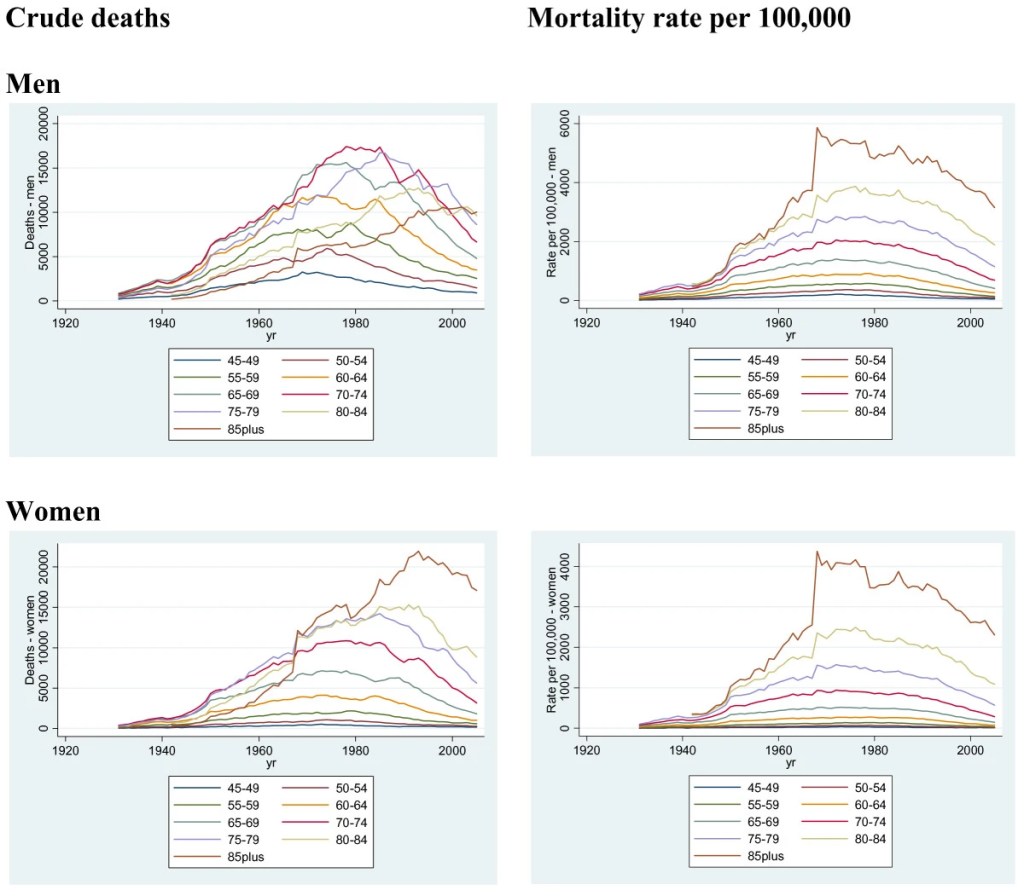
Image source: Allender et al (2008)
Even if we look at non-epidemiological data, we show a significant correlation between saturated fat consumption and increased LDL cholesterol (LDL-C). Meta-analysis after meta-analysis, both in controlled feeding experiments and RCT’s have shown this link.
In fact, many of the TikTok carnivores themselves admit that their LDL-C has risen significantly since starting on carnivore; Coach Carnivore Cam had a result of 3.0mmol/l (when it should be between 1.2-1.7mmol/l) after 18 months on carnivore, Carnivore Ray has an LDL-C of 183mg/dl (4.7mmol/l) after a year on carnivore, and these are just the tip of the iceberg. Looking at posts on r/carnivore, you’ll find numerous people posting about their sky high LDL. The ridiculous thing is, they justify this negative impact of saturated fat consumption by convincing themselves that it doesn’t matter, and LDL is not correlated with cardiovascular disease, despite the relationship between LDL-C and CVD risk being one of the most published and researched connections out there.
The reality is, high saturated fat consumption is an indirect risk factor for cardiovascular disease, through the mechanism of raising LDL-C.
2. Plants have anti-nutrients and are therefore bad for you
You are guaranteed to have come across a topless carnivore on TikTok at least once in your life, walking around a grocery store and picking up and frowning at a broccoli or bag of spinach (Paul Saladino I’m looking at you). They go on and on about how vegetables and beans and legumes are full of “anti-nutrients” and “plant defence chemicals” which mean they are therefore toxic for you and so you shouldn’t eat them.
This is ridiculous.
Yes, plants can contain anti-nutrients, like oxalates, phytates, and other compounds, and yes, these compounds can prevent you from absorbing certain nutrients from the meal, such as iron, iodine and zinc. Does this mean they are bad for you though? NO!
Ultimately, a simple amount of preparation can either remove or inhibit the action of these anti-nutrients. Soaking beans and cooking spinach can remove the oxalates, and fermenting cassava can remove the goitrogens.
Equally, plants do contain some defense chemicals, and this can mean some people struggle to consume them without aggravating a response. People with Mast Cell Activation Syndrome will often respond to histamine, for example. The reality is though, many animal based foods also contain histamines.
Other plant defence chemicals they will often shout about are things such as isothyocyanates, which is hilarious to me. One quick Google search will tell you that these compounds are significantly beneficial to us, and the only harm we see from them is if we drop concentrated amounts in our eyes or on our skin. Genuinely, you can’t make this stuff up.
Whilst carnivores are ranting on about how toxic plant defence chemicals are, they fail to understand that 1. The amount we eat is not enough to harm us (unless we have a specific sensitivity, which is rare). 2. We can remove or reduce the amounts of these we eat by preparing food properly and 3. fruits and vegetables are inherently incredibly good for us, as demonstrated by the decades of nutritional research.
Eat your veggies. They aren’t going to kill you.
3. Fibre is not absorbed and is therefore not necessary for good health.
As with everything carnivore, the initial idea of this is loosely based in truth; they are correct when they say that fibre is (generally) not absorbed and digested. But just because we don’t absorb the nutrients from fibre, doesn’t mean it isn’t good for us.
In fact, it is because we don’t absorb it that it is so good for us. More fibre means more food for our microbiome. More food for our microbiome means a stronger and more diverse microbiome, and also means they can produce short chain fatty acids such as butyrate and propionate. These SCFA’s have been associated with reduced risk of cancer, cardiovascular disease, diabetes, dementia, they have been linked to stronger bones, a better immune system, the list goes on.
You know what hasn’t been linked to any of these things?
Beef, bacon or butter. Lol.
4. You can achieve all of your nutritional needs with a carnivore diet, and nutrients from carnivore sources are more bio-available and therefore better.
This is categorically untrue, and when you point this out to carnivores, they do some crazy mental gymnastics to get around the science.
“Oh but carnivores don’t need vitamin C silly, because we don’t eat carbs! You only need vitamin C if you eat carbs!”
Tell that to the 54 year old Appalachian carnivore who developed scurvy after only eating beef and other cooked animal foods for months. And then went on to develop it again when he stopped taking his vitamin C tablets because he didn’t change his diet. See the gnarly photos below.
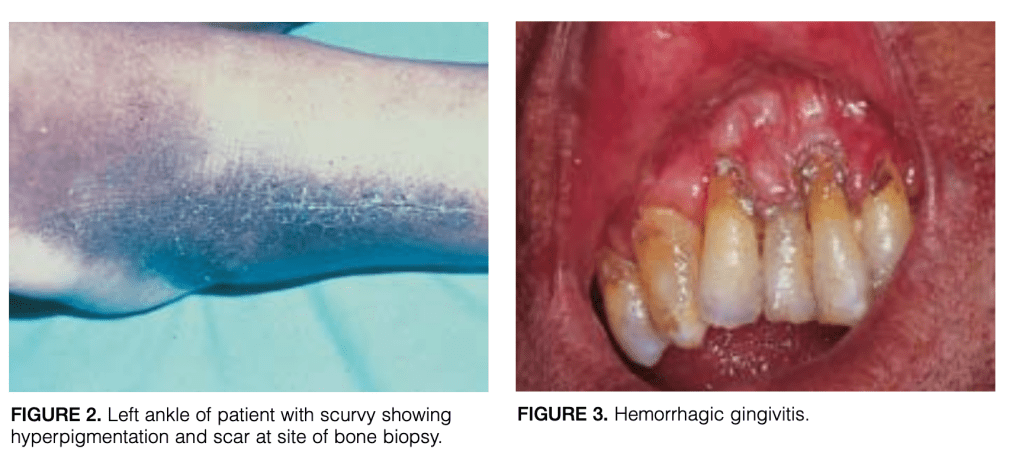
Source: Levin and Greer (2000)
The fact is, there is no medical evidence that suggests that carnivores don’t need vitamin C, a vitamin which is only found in meaningful amounts in plants.
Vitamin C isn’t the only nutrient you’re at risk of being deficient in on carnivore. Potassium, iodine, calcium, magnesium, omega-3’s and thiamine are all nutrients of concern on the ever popular version of carnivore that seems to be followed online, where the bulk of calories come from beef and butter and dairy products and fish are an afterthought. Yes, adding dairy and fish will help reduce the deficiencies seen in calcium, iodine and omega-3, but it won’t do much for the lack of potassium, something which is particularly worrying due to the next point:
5. Salt is good for you and is essential for good health, and you should not limit it.
Excess sodium intake (found in salt) has been shown time and time again to increase blood pressure and increase your risk for stroke and other cardiovascular issues. The average person in the UK does not need to increase sodium intake further; in fact, they need to reduce their sodium intake. Despite this, carnivores are pushing the intake of more salt, justifying it by recommending Celtic sea salts or Pink Himalayan salts as they have “more minerals”.
Yes, they do have more minerals, but they are still just that; salt. Primarily sodium. Equally, the only other mineral which would be most beneficial to consume to combat the effect on blood pressure is exactly the mineral they don’t eat enough of, and is not commonly found in meaningful amounts in salts; potassium.
Potassium essentially works in the opposite way to sodium within the blood. The more potassium you have, the more sodium you can excrete; the more sodium you excrete, the lower the sodium concentration in your blood; the lower the sodium concentration in your blood, the less water there needs to be in your blood to dilute it, and therefore, the lower your blood pressure as there is less fluid in the system.
I’ve actually uploaded a video today talking about the ridiculousness of the claims some carnivores (*cough* Cam *cough) make about salt. Check it out below.
6. Carbohydrates are non-essential and therefore you don’t need to eat them for optimal health.
Just because something is non-essential does not mean it is optimal to not consume it. Anecdotally, epidemiologically and in meta-analyses, we see the consumption of healthy carbohydrates, from wholegrain sources, beans, legumes, fruits and vegetables, are associated with lower cardiovascular disease, cancer and diabetes risks, better energy levels and generally “feeling better”. Especially when those carbohydrates are eaten to replace saturated fats.
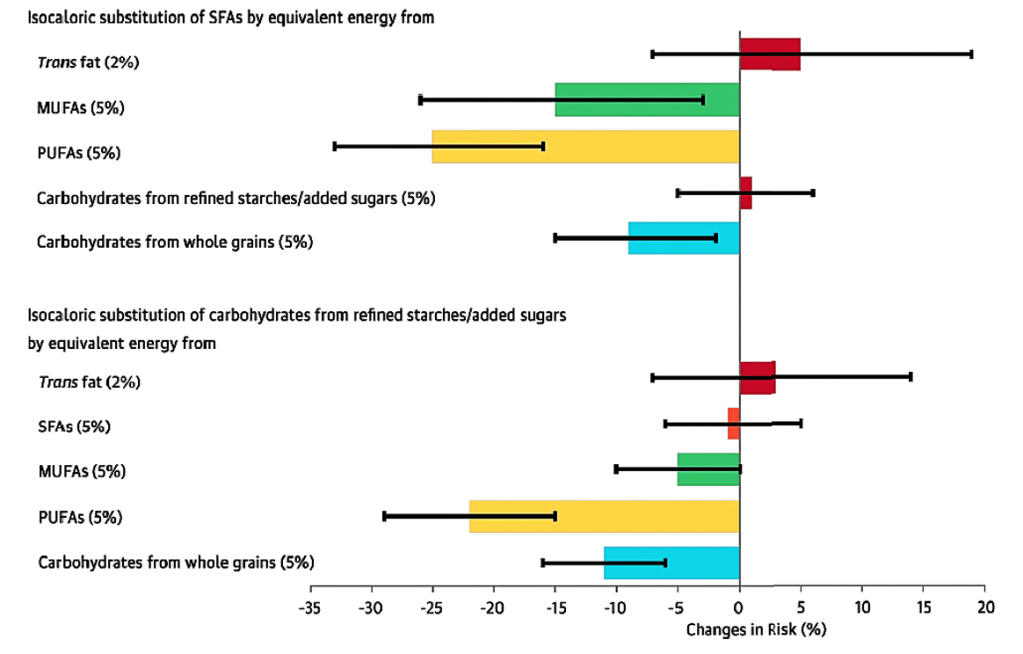
Source: Yanping et al (2015)
Yes, many people in the UK currently consume far too many of the wrong type of carbohydrate. But having 250g carbs from white bread and sugar is very different to having 250g from beans, pulses, whole grains and produce.
Eating carbohydrates not only provides us with easier to use energy, which can make us feel less lethargic, but also fibre, which can help our bowels function properly, feed our microbiome and reduce our risk of hundreds of different diseases. But of course, carnivores don’t believe in fibre. Whowouldathought.
TLDR; carnivore is stupid. Eat your veggies.
 Diets Debunked