
Weight loss can be a challenging journey for many, especially when it feels like you’re constantly battling against hunger, cravings, and the temptation to eat beyond your body’s true needs. Food noise is something many people struggle with, and it can lead to consistently eating more than your body needs, which can lead to weight gain.
One powerful tool that can help individuals struggling with weight loss is mindful eating. This practice involves being fully present and aware while eating, paying close attention to physical hunger and satiety cues, and making conscious decisions about when to start and stop eating.
What Is Mindful Eating?
It is quite astonishing how often people don’t pay attention to how they are feeling, their levels of hunger or levels of enjoyment when they are eating. From my clinical experience, most people who have found weight loss a challenge in the past eat on autopilot, and very rarely pay attention to how the food is making them feel. Whether this be due to being distracted by the TV or a phone, preparing the next bite before even finishing the last, or just continually ignoring fullness cues, these habits can lead to significant overeating at each meal, which adds up over the course of a day, a week, a month or a year.
Instead of eating on autopilot, mindful eating encourages you to think about how the food is making you feel at the time. It is the active engagement of your concentration towards your hunger/satiety levels throughout the meal, your enjoyment and satisfaction when eating the meal, and the way the meal is making you feel as a whole.
When you practice mindful eating, you begin to tune into the natural rhythms of hunger and satiety, which are critical for knowing when to stop eating. This can help you avoid overeating, as well as improve satisfaction with meals and reduce that feeling of guilt, shame or nausea you might experience after overeating. Over time, mindful eating can also help you combat and reduce unhealthy eating patterns, such as emotional eating or mindless snacking.
The Hunger and Satiety Scale: A Tool to Gauge Your Hunger
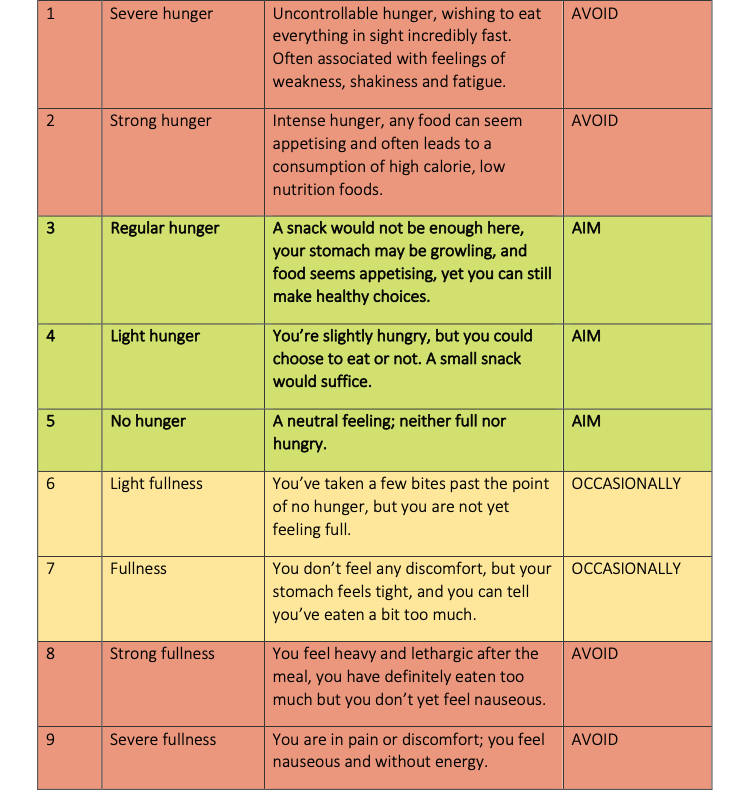
One of the most useful tools for practicing mindful eating is the hunger and satiety scale.
You’ll note that I call this the hunger and satiety scale, and not the hunger and fullness scale. This is because once you have started feeling full, you have generally already eaten too much. Instead, we want to eat to a point of satiety; this is a neutral point, where we are no longer hungry, and it is how we can tell that we have eaten enough.
This scale helps you identify how hungry or full you feel before, during, and after eating. By tuning into your body’s signals and recognising your level of hunger and fullness, you can avoid eating too much or too little.
I recommend for people who are new to the hunger and satiety scale to print it off and have it beside them. That way, you can refer to it after each bite. You’ll probably be surprised at how soon you feel satisfied.
The Hunger and Satiety Scale: Free Download
Here, I have included a copy of the hunger scale, which you can download and print as a PDF. I recommend for people who are new to the hunger and satiety scale to print it off and have it beside them. That way, you can refer to it after each bite. You’ll probably be surprised at how soon you feel satisfied.
How to Use the Hunger and Satiety Scale
Before eating, check in with yourself to identify your hunger level. Aim to eat when you’re around a 3 (regular hunger) or 4 (slightly hungry). Think about it in the context of the rest of your day; if you are at a level 4 currently, but you know you have a few hours of meetings which will stop you being able to eat when you reach a level 3, it’s a good idea to eat something now to tide you over. Usually, a level 4 would indicate a snack is needed, and a level 3 would indicate a meal is needed.
During meals, check in with your hunger scale again. During the beginning stages of using the hunger and satiety scale, you may need to put your fork down between each bite and check in with yourself. When you reach around a 5, this is the ideal time to stop eating, even if there is food left on your plate. This place on the scale shows that you have eaten enough, but not too much to where you have stuffed yourself.
It is important to take your time with a meal to ensure you can interpret your feelings of hunger and satiety properly. There are two mechanisms by which we feel full; a physical sensation, where your stomach will stretch and tell you you’ve had enough, and a hormonal response, where the levels of hunger and satiety hormones in your body as you eat. Whilst the stretch receptors which tell you that you are physically full don’t require a time period to activate, our hormones do. Generally, it takes 15-20 minutes after the first bite for those hormones to reach a level to say we’ve had enough. So, if you eat too quickly, you’ll end up feeling physically satisfied (level 5) after perhaps 10 minutes, but you’ll continue to become fuller due to the hormone levels changing. Therefore, what you thought was a level 5, may actually be a level 6 or 7, and you accidentally overate.
The Vicious Cycle of Dieting
Just as important as not over eating, is not under eating too. One fatal mistake many people make when they are dieting is to starve themselves and let themselves get too hungry, with the idea that eating less = more weight loss.
The reality is, if we let ourselves get to level 1 or 2 on the Hunger and Satiety scale, we often get so hungry we cannot make sensible decisions about the food we eat. We want food, and we want it now. This generally leads us to make poor choices; a chocolate bar, some crisps or some biscuits are easy and ready prepared. We will likely reach for these over spending 20 minutes making a meal. Equally, if you’re really hungry, you are going to be more likely to eat very quickly and therefore overeat. This can add to feelings of guilt, which can make you feel as though the best course of action is to starve yourself again, and so the cycle continues. Therefore, avoiding the top end of the scale will mean you are in a better place to make good choices when you’re eating, rather than falling back on pre-prepared and less nutritious snacks.
Types of False Hunger: How to Tell When You’re Really Hungry
Many people struggling with weight loss eat because of emotional triggers or external cues, rather than actual physical hunger. Recognising false hunger can help you differentiate between when your body truly needs food and when you’re eating for other reasons.
Common Types of False Hunger
- Comfort Hunger: Eating in response to stress, sadness, boredom, or anxiety, rather than physical hunger. Emotional eating often leads to mindless or overeating, as it doesn’t address the actual feelings or emotions behind the urge to eat. It is a coping mechanism; therefore, if you are struggling with this type of hunger, it is important to address it in therapy or with a dietitian such as myself to reduce the risk of it continuing on in the future.
- Pleasure Hunger: This can occur in 2 ways; either, you are really enjoying the food you are eating, and so you eat past the point of satiety; or you eat as a reward or as a treat, despite not being hungry.
- Habitual Hunger: Eating because it’s “time to eat,” or because it’s a specific time of day, regardless of whether you’re hungry. You may also eat because you associate whatever you’re doing with eating; for example, sitting in front of the TV and craving biscuits, or working at your desk and wanting to pick on something.
- Environmental Hunger: Eating due to external cues, such as seeing food on an advert, smelling food from a bakery on your commute to work, or being around others who are eating. These cues can override your body’s actual hunger signals, leading you to eat when you’re not truly hungry.
- Rational Hunger: This is a type of hunger very common in those who are looking to diet and lose weight; you may overeat “healthy” foods by rationalising that they are good for you. The reality is, it’s still overeating whether you’re eating healthy foods or not.
- Cravings: While cravings can be part of the body’s actual need for nourishment (like a craving for chocolate or salty foods), they are often psychological urges for specific tastes or textures, rather than true hunger. It’s important to distinguish between the body’s need for nutrients and the desire for specific food items for emotional or habitual reasons.
False hunger comes on suddenly, unlike true hunger which is a more gradual wave of hunger. It can be difficult to ignore and often will not go away until you give in. Therefore, it is important that we recognise which type of hunger we are experiencing and the trigger for that hunger, so we can either change the situation or avoid that trigger to prevent a reoccurrence. Ideally, we should only eat when we have true, physical hunger.
False hunger comes on suddenly, like a riptide or a tsunami, unlike true hunger which is a more gradual wave of hunger. False hunger will also not be satisfied with any kind of food, whereas you could eat anything when you are truly hungry and it would quell the hunger. It is important that we recognise which type of hunger we are experiencing and the trigger for that hunger, so we can either change the situation or avoid that trigger to prevent a reoccurrence. Ideally, we should only eat when we have true, physical hunger.
How to Manage False Hunger
- Check in with yourself: If you’re craving food but don’t have physical hunger signs (like an empty stomach or low energy), pause and reflect on whether the desire to eat is due to emotions, habits, or external cues.
- Engage in a mindfulness practice: Practice techniques like deep breathing, journaling, or meditation to explore your emotions before eating. Often, emotional hunger can be managed with strategies other than eating.
- Use the hunger scale: Before reaching for food, rate your hunger level on the scale. If you’re not between a level 3 & 4, you may not be actually needing to eat food.
Food Noise: How to Tune Out External Cues
“Food noise” refers to external signals or internal mental chatter that may influence your desire to eat, even when your body isn’t physically hungry. This could be:
- Seeing food advertised on TV
- Smelling food in the environment
- Being around people who are eating
- Constant thoughts about food (“I should be eating right now” or “I can’t resist this dessert”)
Food noise can be very powerful, especially in a world where food is constantly marketed to us, often triggering an emotional or automatic response. One way to combat food noise is by practicing mindful awareness; noticing the thoughts or cues you’re responding to, but choosing not to act on them unless you feel true hunger.
How to Quiet Food Noise
- Pause before eating: Take a few moments to check in with yourself. Ask yourself, “Am I truly hungry right now, or is something else driving me to eat?”
- Reframe your thoughts: If you find yourself thinking about food when you’re not hungry, challenge those thoughts by asking yourself, “What am I really feeling right now? Am I eating to cope with stress, boredom, or another emotion?”
- Create mindful rituals around meals: Set aside distractions like phones or TV during meals. Focus solely on your food and your eating experience. This helps to separate eating from external cues or distractions.
Fullness Cues: How to Recognize When to Stop Eating
Recognizing fullness cues is essential for stopping eating at the right time. Many people struggle with overeating because they don’t tune into their body’s signals or don’t know what fullness feels like.
Common Fullness Cues
- Feeling satisfied: You no longer feel hungry, and you start to feel content with your meal.
- Loss of interest in food: You find that you’re no longer thinking about food and don’t feel compelled to keep eating.
- Reduced enjoyment of food: you often may not be finding the food as delicious as you did with your first few bites.
How to Stop Overeating
- Eat slowly: It takes about 20 minutes for your brain to register that you’re full. Eating more slowly gives you time to notice fullness cues before you overeat.
- Check in periodically: Throughout the meal, pause to assess your hunger and fullness level. Are you at a 5 on the hunger scale? If yes, it’s time to stop.
- Practice portion control: Start by serving smaller portions and giving yourself permission to stop eating when you’re full, even if there’s food left.
Conclusion
Incorporating mindful eating into your daily routine can make a significant difference in your weight loss journey. By tuning into the hunger and satiety scale, identifying false hunger, reducing food noise, and learning how to listen to fullness cues, you can make more intentional decisions about when and how much to eat. Mindful eating isn’t about restriction or willpower; it’s about developing a deeper connection to your body’s natural signals and nourishing it in a way that feels right for you.
The more you practice mindfulness around eating, the easier it becomes to recognize when you’re truly hungry or full, which can help you create sustainable, healthy eating habits that support your weight loss goals. Start small, be patient with yourself, and allow mindful eating to guide you toward a more balanced and empowered relationship with food.
If you’d like more help with mindful eating, knowing when to eat and when to stop, or help with managing emotional eating, get in contact with us now; we can help you have a more mindful eating experience and reduce the guilt and shame that can come with overeating.
 Diets Debunked