
When it comes to managing your blood glucose (sugar) levels, two key terms often come up: glycaemic index (GI) and glycaemic load (GL). These concepts are especially important for individuals with diabetes, or those looking to maintain stable blood glucose levels.
While they are related, GI and GL measure different aspects of how carbohydrate-rich foods affect blood glucose. Understanding the difference can help you better understand the effect a food will have on your blood glucose levels.
What is Glycaemic Index (GI)?
The glycaemic index is a ranking system that measures how quickly carbohydrate-containing foods raise blood sugar levels after they are eaten. The GI scale ranges from 0 to 100, with pure glucose set at 100 for reference.
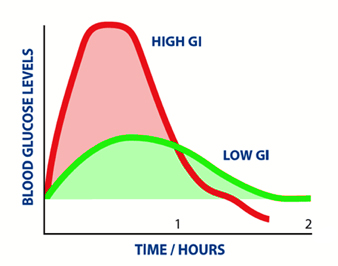
- Low GI foods (55 or less): These foods cause a slow and steady rise in blood glucose. They are digested more slowly, which can help to keep you feeling fuller for longer. Their curve on a graph looks flat and tends to last a longer time, not causing a glucose spike.
- Medium GI foods (56-69): These foods lead to a moderate rise in blood glucose, which may cause an increase in energy, but without the crash that comes with high GI foods. Their curve on a graph looks a little more raised than for low-GI, but they don’t cause a large spike.
- High GI foods (70 or more): These foods are rapidly digested and absorbed, leading to a quick spike in blood glucose levels followed by a crash. This can lead to hunger and cravings soon after eating. Their curve on a graph shows a rapid rise, then fall, in blood glucose levels.
Examples of Foods and Their GI Values:
- Low GI:
- Lentils (GI = 21)
- Chickpeas (GI = 28)
- Sweet potatoes (GI = 44)
- Apples (GI = 38)
- Medium GI:
- Brown rice (GI = 68)
- Whole wheat bread (GI = 69)
- Bananas (GI = 51)
- Mangoes (GI = 56)
- High GI:
- White bread (GI = 70)
- White rice (GI = 73)
- Cornflakes (GI = 81)
- Watermelon (GI = 80)
As you can see, high GI foods tend to be processed or refined, whereas low GI foods are often less processed, such as beans and whole grains. There are exceptions to this rule though, such as watermelon; this has a high GI of 80, which puts it at a similar GI as refined carbohydrates. Therefore, we can see that the GI is not a perfect system, and needs to be adjusted to make sure people can still feel comfortable consuming healthy foods.
What is Glycaemic Load (GL)?
The glycaemic load builds on the concept of glycaemic index, but takes into account both the GI of a food and the amount of carbohydrate it contains per serving. This is important because a food’s GI alone doesn’t give the full picture. For example, watermelon has a high GI, but it’s mostly water, so the total amount of carbohydrate in a typical serving is relatively small. Equally, a food which contains a lot of fat, such as a chocolate bar, may have a lower GI (of approximately 60) and therefore people may assume that it can be a better alternative to watermelon. The glycaemic load aims to differentiate between the two and give a more practical, common sense approach to identifying the impact on blood glucose, by giving a more practical measurement of how a food will actually affect blood glucose when consumed in a typical portion size. It is calculated as:
GL= GI x carbohydrate content per serving (g) /100
- Low GL: 10 or less
- Medium GL: 11-19
- High GL: 20 or more
By considering both the quality (GI) and quantity (carb content) of carbohydrates, GL provides a better understanding of the blood sugar impact of different foods.
Examples of Foods and Their GL Values:
- Low GL:
- Watermelon (GL = 5)
- Apples (GL = 6)
- Chickpeas (GL = 7)
- Mangoes (GL= 8)
- Lentils (GL = 8)
- Sweet potatoes (GL = 10)
- Medium GL:
- Bananas (GL = 12)
- High GL:
- Cornflakes (GL = 21)
- Brown rice (GL = 27)
- Brown bread (GL= 30)
- White rice (GL = 34)
- White bread (GL= 43)
As you can see, the glycaemic load takes into account the impact the portion size has on your blood glucose levels. This is a better way of looking at the potential spikes in blood glucose; however, it must be noted that it is still not perfect.
What Else Can Impact a Food’s Glycaemic Load?
What you eat alongside a food can also have an impact on how it will spike your blood glucose. For example, having a high GL food such as brown bread with a source of protein, fat and fibre, (such as avocado and poached eggs on toast) can significantly reduce the blood glucose spikes and therefore the glycaemic load of the food. Therefore, if you want to have a food with a higher glycaemic load, having it alongside other foods that are high in protein, fat and fibre is key to prevent blood glucose spikes.
Why is Glycaemic Load Important?
Glycaemic load gives a clearer indication of the effect a food has on your blood glucose, making it a more reliable guide when planning meals, particularly for people with diabetes. Foods with a low GI and GL will cause slower, more controlled changes in blood glucose, helping to reduce the risk of insulin resistance, fatigue, and cravings.
For instance, although watermelon has a high GI (80), its GL is relatively low (5), meaning it has a smaller impact on blood glucose in typical serving sizes. In contrast, white rice has a higher GL (34), which indicates it may cause a quicker, larger rise in blood glucose.
How to Use Glycaemic Index and Glycaemic Load in Your Diet
To achieve balanced blood glucose levels and maintain energy throughout the day, try incorporating more low-GL foods into your meals. Here are a few simple strategies:
- Combine foods wisely: Pair high-GI foods with low-GI foods to help balance out the overall GL of the meal. For example, add a handful of lentils to a serving of brown rice, or enjoy an apple with a portion of nuts. The protein, fat and fibre rule is key here; never eat a naked carbohydrate!
- Choose whole grains: Whole grains like brown rice, quinoa, and whole wheat bread typically have a lower GI and GL compared to their refined counterparts, such as white rice or white bread.
- Eat more vegetables and legumes: Vegetables, particularly non-starchy ones like leafy greens, and legumes like beans, lentils, and chickpeas are generally low in GI and GL, and are great for stabilising blood glucose levels.
- Be mindful of portion sizes: A food with a high GI might not cause as much of a blood sugar spike if you consume a small portion. However, larger portions of even low-GI foods can have a significant effect if the carbohydrate content is high.
Conclusion
Understanding the difference between glycaemic index and glycaemic load can help you make more informed decisions about the foods you eat and how they will affect your blood sugar. While GI measures the speed at which foods raise blood sugar, GL takes into account both the quality and quantity of carbohydrates, providing a more practical view of how foods impact blood glucose levels.
By focusing on low-GL foods, particularly whole grains, legumes, and non-starchy vegetables, you can better manage your blood sugar and avoid the energy dips that come from eating high-GI foods. Incorporating a variety of foods with low to moderate GL values into your diet can help to maintain stable energy levels throughout the day and reduce blood glucose spikes, an effective strategy for improving your chance of type 2 diabetes remission.
References:
- Image reference: https://www.flabstofitness.com/blog/glycemic-index
- Jenkins, D. J., et al. “Glycaemic index of foods: A physiological basis for carbohydrate exchange.” The American Journal of Clinical Nutrition, 1981.
- Foster-Powell, K., et al. “International table of glycaemic index and glycaemic load values.” The American Journal of Clinical Nutrition, 2002.
 Diets Debunked